Intent Data vs. Buying Signals: A Complete Guide for B2B Revenue Teams
Most B2B teams treat intent data and buying signals as synonyms. They are not. Intent data tracks anonymous research behaviour. Buying signals are verifiable business events. This guide covers the difference, the limitations of each, and how to combine both.


Intent data tracks anonymous research behaviour — which companies are consuming content about topics related to your category, typically sourced from third-party content co-ops like Bombora's network of 5,000+ B2B publisher sites. Buying signals are observable business events that indicate structural change — a new executive hire, a funding round, a regulatory filing, a new subsidiary registration, a technology adoption. Intent data infers readiness from anonymous behaviour. Buying signals infer readiness from verifiable events. The two are complementary, not competing: intent data tells you who is researching; buying signals tell you why an account is likely to buy right now. For global markets including APAC and MENA, third-party intent data has significant structural limitations because it draws from English-language co-ops that do not cover local-language research behaviour. Locally-sourced buying signals fill this gap.
Here is a fact that surprises most B2B revenue leaders: 31% of sales leaders describe intent data as "the most overrated technology in their stack". Not ineffective. Not unreliable. The most overrated. This is a technology category worth $4.5 billion in 2025, growing at 15.9% CAGR — and nearly a third of the sales leaders who buy it feel it underdelivers on its promise.
Understanding why starts with understanding what intent data actually is — and how it differs from buying signals, a term that is often used as a synonym but describes something meaningfully different.
What is intent data?
B2B intent data is behavioural information that signals when a company is researching, evaluating, or preparing to purchase a specific product or service. Think of it as digital body language at the company level. When employees at a target account start reading articles about workflow automation, downloading vendor comparison guides, or visiting category review sites, that behavioural pattern — aggregated across an organisation — is intent data.
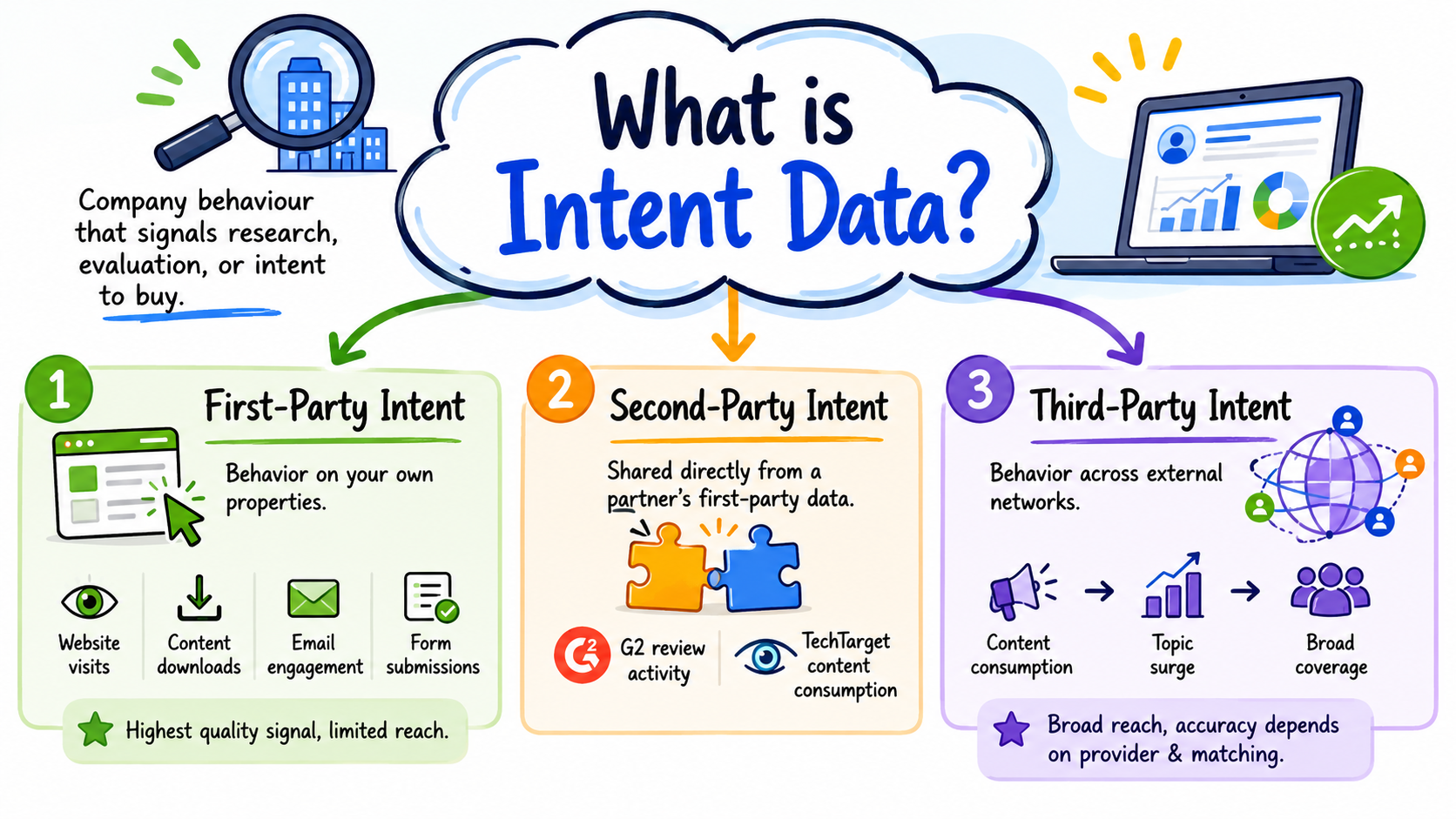
Intent data comes in three types:
First-party intent tracks behaviour on your own properties — website visits, content downloads, email engagement, form submissions. This is the highest-quality signal because you know exactly who interacted and what they did. The limitation is reach: you only see accounts that have already found you.
Second-party intent sits between the two — data shared directly from a partner's first-party sources, such as G2 review site activity or TechTarget content consumption.
Third-party intent tracks behaviour across external networks. Bombora's cooperative of 5,000+ B2B publisher sites is the most widely used example — when companies at your target accounts consume content about topics related to your solution across this network, Bombora surfaces a "topic surge." Coverage is broad, but accuracy depends on provider data sources, matching methodology, and whether the research behaviour happens within that network's reach.
What are buying signals?
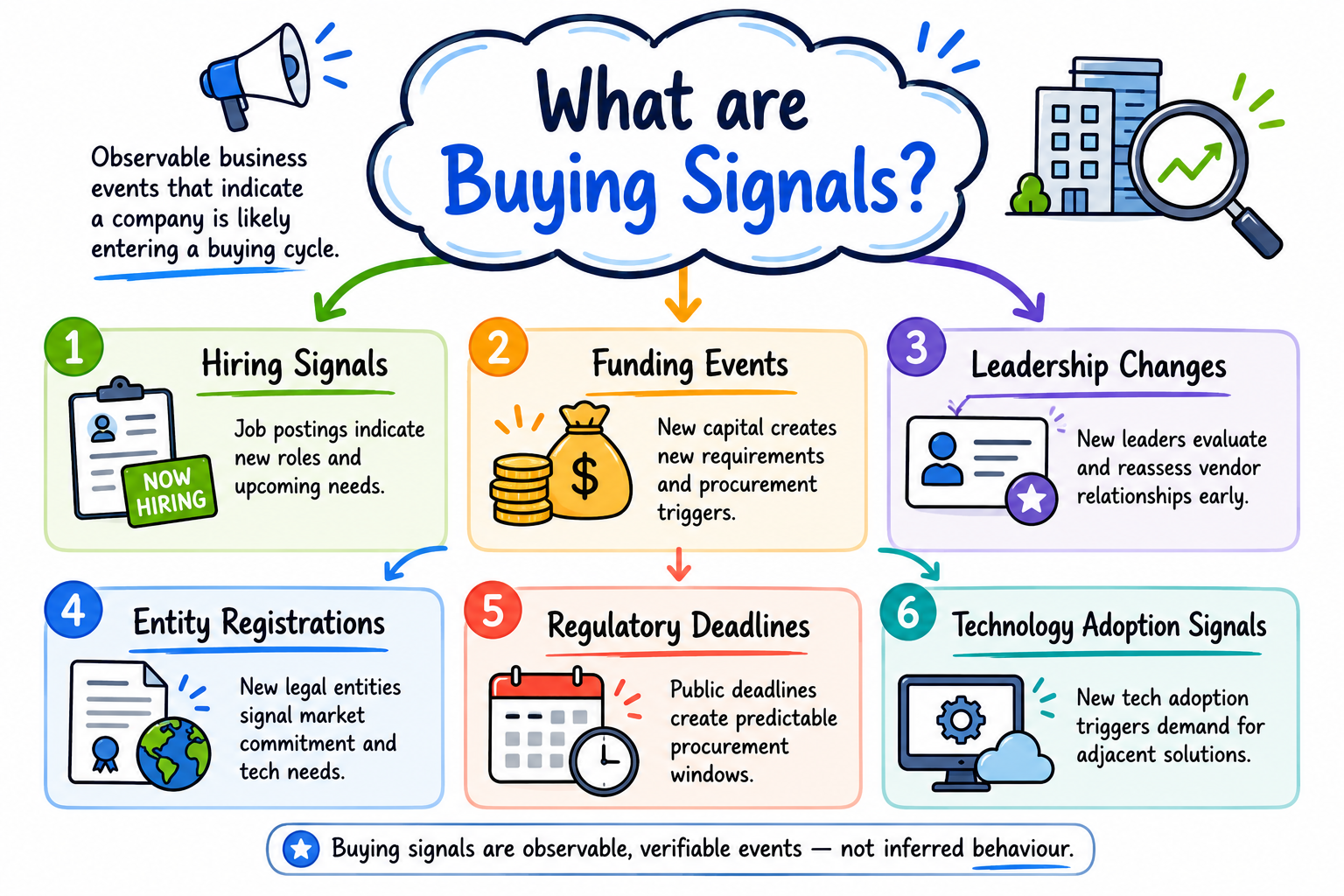
Buying signals are a different category entirely. Where intent data infers readiness from anonymous research behaviour, buying signals infer readiness from observable business events — verifiable things that happen to a company and indicate it is likely entering a buying cycle.
Buying signals include:
Hiring signals — a company posting ten SDR roles is almost certainly evaluating CRM and sequencing tools. A company hiring a Chief Compliance Officer is entering a regulatory evaluation cycle. The job posting is a public event, not an inferred behaviour.
Funding events — a Series B announcement is a procurement trigger. New capital creates new infrastructure requirements and new technology mandates — and a company that just raised does not wait months before evaluating vendors.
Leadership changes — a new CRO or VP of Sales evaluates inherited vendor relationships within the first 90 days. This is a documented and repeatable pattern, not a behavioural inference.
Entity registrations — a company registering a new subsidiary in a country is making a legally binding commitment to that market. Technology procurement for that market has already started. The registry filing is the signal.
Regulatory deadlines — publicly announced rulemaking creates defined procurement windows. DORA entering into force in January 2025 created a mandatory technology evaluation cycle for every EU financial institution. The deadline was public; the procurement window was predictable.
Technology adoption signals — a company adopting a new ERP creates immediate demand for adjacent tools. The technology deployment is verifiable through job postings, press releases, and local trade press — not inferred from content consumption.
The key differences — and where each falls short
The distinction matters most when teams rely exclusively on one or the other.
Intent data: what it misses
The same-signal problem. If five vendors all receive a Bombora spike for the same account, that account receives five cold emails in the same week. Intent data from major co-ops is available to every subscriber simultaneously. The information advantage disappears the moment your competitors subscribe to the same feed.
The remote work gap. Intent data typically uses IP address matching to identify which company a researcher belongs to. With 35–45% of B2B buyers working remotely at least part-time in 2026, a growing share of research behaviour cannot be matched to a company — the remote worker's home IP does not identify their employer. VPNs compound this further.
The lag problem. Most intent data has a 1–7 day lag between behaviour and delivery. In fast-moving sales cycles, a week-old signal may already represent a deal in progress with a competitor who had the signal earlier.
The specificity problem. "Intent for CRM" can mean anything from an intern researching what a CRM is to a VP of Sales with budget approved actively evaluating three vendors. Intent data does not distinguish between these scenarios. The signal tells you the topic; it does not tell you the stage or seriousness.
The geography problem. Third-party intent co-ops are built from English-language B2B publisher networks. A procurement team in Indonesia, a compliance officer in Saudi Arabia, or a technology buyer in Vietnam researching solutions in local-language sources generates zero signal in Bombora or 6sense. As of 2026, buyers increasingly research vendors through AI tools like ChatGPT and Perplexity — interactions that are invisible to traditional intent data providers entirely.
Buying signals: what they add
Buying signals do not have the anonymous research problem, because they are not based on anonymous behaviour. A funding round is publicly announced. A job posting is publicly accessible. A registry filing is a legal document. These are verifiable facts — which means multiple teams can access them, but the signal itself is unambiguous in a way that "topic surge" is not.
The structural advantage of buying signals for global markets: they are generated by the company itself, through local-language registries, regional job boards, and local-language trade press. A company expanding into Indonesia generates buying signals in the Indonesian business registry, in Indonesian job boards, and in Indonesian trade publications — regardless of whether it maintains an English-language profile. This is why locally-sourced buying signals reach markets that intent data structurally cannot.
The limitation: buying signals tell you an account is in motion, but not necessarily that they are evaluating your specific category. A funding round is a buying signal for dozens of product categories simultaneously. The specificity is lower than a content consumption signal for a specific topic.
| Dimension | Third-party intent data | Buying signals (Pubrio Expansion Signals) |
|---|---|---|
| Signal basis | Inferred from anonymous research behaviour across content co-ops | Verifiable business events — hiring, funding, entity filings, technology adoption |
| Competitive exclusivity | Shared with all co-op subscribers — multiple vendors receive the same signal simultaneously | Local-source signals surface before national platforms carry them — timing advantage varies by market |
| Specificity | Topic-level — "company researching CRM" without knowing seriousness or stage | Event-level — verifiable but not category-specific without additional context |
| Remote work impact | Significant — IP matching fails for home networks and VPN users (35–45% of buyers) | Not affected — signals sourced from public registries and job platforms, not IP tracking |
| Global market coverage | Limited to English-language publisher networks — APAC and MENA research in local languages not captured | Local-source signals from 130+ countries — local job boards, registries, and trade press in each market |
| Signal delivery lag | Typically 1–7 days between behaviour and delivery | Registry filings and job postings monitored continuously — signals surface at point of publication |
| AI research invisibility | ChatGPT and Perplexity research leaves no signal in intent co-ops — growing dark funnel problem | Not affected — buying signals are structural events, not research behaviour tracking |
How to use intent data and buying signals together
The answer to "intent data or buying signals?" is almost always both — used for different purposes at different stages of the pipeline motion.
Use intent data to identify in-market accounts within your existing universe. First-party intent (your own website and content engagement) is the highest-quality signal you have — prioritise it first. Third-party intent from platforms like Bombora or 6sense helps surface accounts researching your category that have not yet engaged with you directly. This is genuinely useful for prioritising known accounts within your ICP and triggering timely outreach.
Use buying signals to find accounts before they enter your known universe. A company that just filed a new subsidiary in Indonesia, posted ten compliance roles on a regional job board, and announced a partnership in local trade press — all within 30 days — is almost certainly entering a buying cycle. None of this appears in any intent co-op. It requires locally-sourced signal monitoring to detect.
Use signal clusters, not individual signals. The highest-converting combination is not a single signal of either type — it is a cluster of corroborating signals within a defined time window. A funding event plus a VP of Sales hire plus a technology adoption signal within 30 days is a buying window. A topic surge for "CRM software" alone is a weaker trigger. According to 6sense's research, 95% of deals go to the vendor already on the buyer's Day One shortlist — which forms during the 61% of the journey that passes before a buyer contacts any vendor. Signal clusters are how you get onto that shortlist before it closes.
For global markets, supplement English-language intent with local-source buying signals. Third-party intent data structurally cannot capture research behaviour in local-language markets. Pubrio's Expansion Signal layer generates 120,000+ daily buying indicators from local ecosystems across 130+ countries — hiring signals from regional job platforms, funding events from local financial publications, entity filings from country-specific registries, and partnership announcements from local-language trade press. For revenue teams targeting APAC and MENA, this is the signal layer that complements what intent data cannot reach.
A practical example of both working together
Consider a revenue team selling compliance software into Southeast Asia. Their third-party intent data shows a Singapore-headquartered financial services firm showing a topic surge for "regulatory compliance software" — useful, but shared with every competitor on the same platform.
Meanwhile, Pubrio's Expansion Signal layer shows the same firm has posted three compliance officer roles on JobsDB and MAS TRM-related roles in the past 14 days, while a partner publication in Singapore trade press reports a new regional expansion into Thailand. None of these signals appear in any intent co-op.
The intent signal tells them the account is researching. The buying signals tell them why: a new market entry, a regulatory hiring push, and the staffing investment to build a compliance function for it. Together they produce a prioritised, high-context account with a clear reason to reach out — and a specific message to send.
from Local Ecosystems