
Pubrio Expansion Signals: All 16 Types Explained for B2B Revenue Teams
Pubrio tracks 16 signal types across 4 expansion stages — Exploring, Committing, Expanding, Scaling. Each signals a different level of market commitment. This is the complete breakdown of all 16, what they mean, and what outreach they warrant.

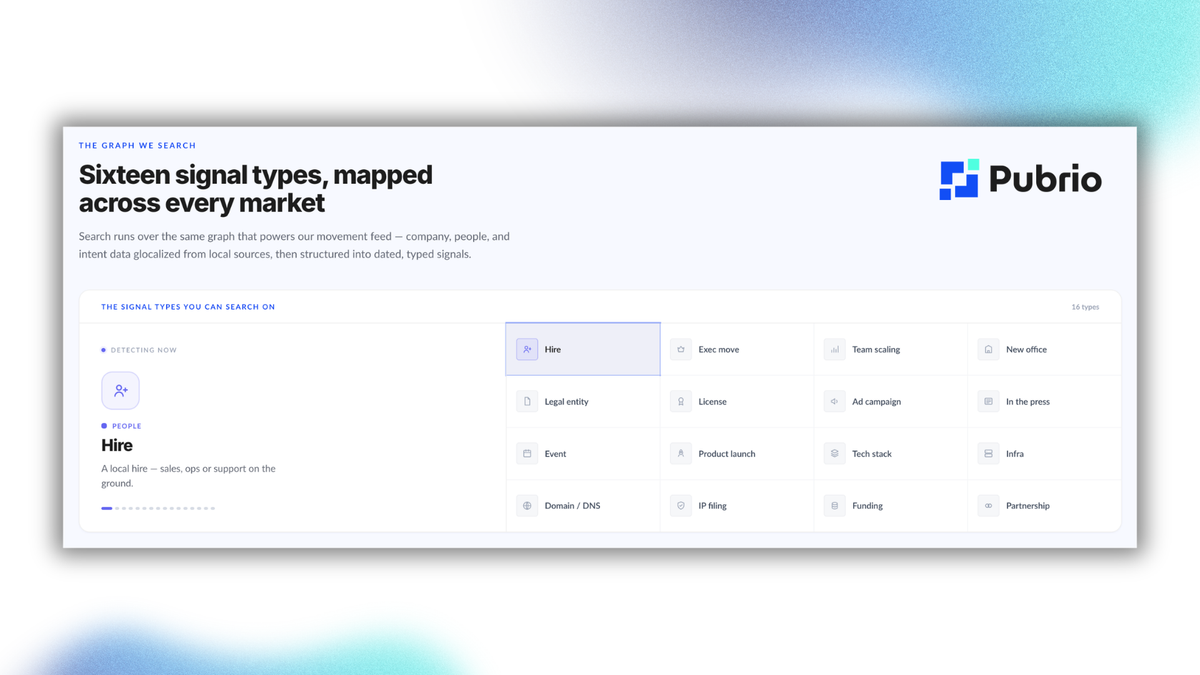
Pubrio tracks 16 signal types structured across four expansion stages: Exploring, Committing, Expanding, and Scaling. The 16 types are: Hire, Exec move, Team scaling, New office, Legal entity, License, Ad campaign, In the press, Event, Product launch, Tech stack, Infra, Domain/DNS, IP filing, Funding, and Partnership. Each signal is dated and sourced from local registries, regional job platforms, local-language trade press, and other local data sources across 200+ markets — refreshed daily. The same signal type can appear at different stages depending on context: a Hire at Exploring stage means an exploratory business development role; a Hire at Committing stage means a country lead being placed. Pubrio's system assigns stage based on the signal cluster, not a single data point.
Not all market entry signals carry the same weight. An ad campaign in a new market tells you a company is testing. A legal entity filing in that same market tells you the decision is made. Treating both as equivalent — or worse, missing the entity filing entirely because your data tool does not index local registries — means reaching out at the wrong time with the wrong message.
Pubrio's Search product tracks 16 signal types across a live graph of 800M+ companies in 200+ markets. Every signal is dated and sourced. The stage — Exploring, Committing, Expanding, or Scaling — is determined by the cluster of signals, not a single data point. A company showing a Domain/DNS registration, a Partnership announcement, and a Hire in the same market within 30 days is at a different stage from one showing only a single Hire.
This is the complete breakdown of all 16.
The 16 signal types
People signals
1. Hire — a local hire: sales, operations, or support on the ground. At Exploring stage, typically a business development or market research role. At Committing or Expanding stage, a country lead, sales director, or operations hire. The most common signal type across all four stages.
2. Exec move — a senior executive placed in the target market: country manager, General Manager, VP of Sales, or regional director. Higher commitment than a standard hire. A new country exec evaluates all vendor categories within their first 90 days — the outreach window is 30–90 days from the announcement.
3. Team scaling — sustained headcount growth across the local team at pace. Indicates the Scaling stage: the company is no longer building the market — it is operating and expanding it. The procurement wave at this stage is the enterprise upgrade cycle, replacing entry-level tools with scaled infrastructure.
Presence signals
4. New office — office lease signed or opening announced. Physical presence committed. On the live Pubrio product page, Arrow Electronics shows a New office signal at Committing stage (China); Celestica shows New office at Expanding stage (Malaysia). The same signal type appears at different stages depending on what accompanies it.
5. Legal entity — entity registration in the country's official business registry. The highest-confidence single signal Pubrio tracks. Appears at Expanding stage. On the live Pubrio product, Yokogawa shows Legal entity at Expanding stage (Vietnam); Sandals shows Legal entity registered at Expanding stage (US). Act within 2–6 weeks.
6. License — regulatory licence application or approval in the target market. A financial services licence, healthcare permit, or technology sector certification. Defines the procurement need precisely: every licensed entity needs compliance tools and reporting infrastructure specific to that licence type.
Marketing signals
7. Ad campaign — geo-targeted advertising in a new market. At Exploring stage, a company testing demand before committing. On the live Pubrio product page, RWS Global shows an Ad campaign at Scaling stage — at that stage, advertising signals market deepening rather than initial entry. Context determines the stage.
8. In the press — news or PR coverage mentioning a new geography: a CEO interview referencing expansion plans, analyst coverage of international ambitions, or trade press coverage of a new market move.
9. Event — exhibiting or speaking at a regional industry event. A trade show presence, conference sponsorship, or speaking slot at a local industry gathering. At Committing stage, this indicates investment in market visibility before operational commitment is made.
Product signals
10. Product launch — a local product launch, a localised product version, or a market-specific feature release. At Scaling stage, indicates the company is committing to the local customer beyond just a sales presence.
11. Tech stack — adoption of new technology infrastructure for the target market: a new regional CRM instance, a localisation platform, or market-specific software deployment. Adjacent technology vendors — integrations, data enrichment, localisation tools — have an immediate opening.
12. Infra — cloud or infrastructure procurement for the target market: data centre commitments, CDN configuration, or regional hosting decisions. Security, compliance, and data residency vendors should act on this signal at Committing stage.
Digital signals
13. Domain / DNS — registration of a country-specific domain (.vn, .id, .sa, .de) or DNS configuration for a new market. Precedes most other market entry steps. At Committing stage, indicates digital infrastructure being built before operational presence.
14. IP filing — trademark or patent filing in the target market. A legal protection decision: the company is defending its brand in a new jurisdiction. Compliance and IP-adjacent technology vendors have a clear procurement opening.
Growth signals
15. Funding — a funding round mentioning international expansion or a new geographic mandate. On the live Pubrio product page, Thoughtworks shows Funding at Exploring stage (India). Capital earmarked for expansion creates procurement needs across every vendor category relevant to the target market. Act within 4 weeks of announcement.
16. Partnership — a local partnership announced: a regional distributor, reseller agreement, joint venture, or strategic alliance. At Committing stage, the partner network is being built before operational presence is established. Vendors who complement the partner's offering have a natural co-sell angle.
Stage is determined by the signal cluster, not a single type
The same signal type can appear at different stages. On Pubrio's live product, Hire appears at both Exploring and Committing. Ad campaign appears at Scaling. New office appears at both Committing and Expanding. Funding appears at Exploring.
Pubrio assigns stage — Exploring, Committing, Expanding, or Scaling — based on the full signal cluster: which signal types have appeared, in which sequence, over what time window. A company showing Domain/DNS + Partnership + Hire in the same market within 30 days is at a different stage from one showing a single Hire with no other signals. The cluster is the signal.
This is why Pubrio's Search returns a live expansion dossier rather than a contact record — it shows every dated signal in context, so the stage assessment reflects the full picture, not a single data point.
800M+ companies. 50+ local data sources. 16 signal types. 200+ markets. Daily refresh.
"We reach accounts the week they land in-market — not the quarter after." — Head of Growth, 500+ person revenue team on Pubrio
See Its Whole Move.