
Smarter Agents, Global Reach: The OttoKit x Pubrio Integration
OttoKit's AI agents execute workflows across 1,400+ apps. Pubrio's glocalized data layer covers 130+ countries from 50+ local sources. Together they let your agents prospect, enrich, and act in global markets — including APAC and MENA where standard data tools return empty.

OttoKit is a no-code AI workflow automation platform connecting 1,400+ apps — formerly known as SureTriggers, rebuilt with AI agents, MCP support, and a visual workflow builder. Pubrio is a glocalized B2B data layer covering 1B+ profiles from 50+ local registries across 130+ countries. The integration connects them directly: OttoKit agents can pull verified local company data, firmographics, and Expansion Signals from Pubrio mid-workflow — enriching leads, verifying accounts, and personalising outreach in any market, including APAC, MENA, and non-English Europe where standard data tools return empty. Setup takes under five minutes from OttoKit Settings > Integrations > Data Providers > Pubrio.
AI agents are only as good as the data that guides them.
An agent that knows which workflows to trigger, which apps to connect, and which steps to automate — but is working from incomplete or inaccurate data about the account it is acting on — will execute the wrong action with perfect precision. Automation amplifies whatever is underneath it. If the data layer is thin, the agent's reach is thin.
This is the problem the OttoKit x Pubrio integration solves. OttoKit provides the automation layer — a no-code AI workflow platform connecting 1,400+ apps, with AI agents that monitor conditions, apply logic, and act across tools without requiring manual intervention. Pubrio provides the global intelligence layer — 1B+ verified company and contact profiles sourced from 50+ local sources across 200+ markets, including the markets where standard data tools return empty fields.
Together they close the gap between automation capability and data coverage — giving agents the verified, locally-sourced context they need to act intelligently in any market.
Automating B2B data enrichment workflows using Pubrio and Ottokit.
What each platform brings
OttoKit is a no-code workflow automation platform — formerly SureTriggers, relaunched as OttoKit in June 2025 to reflect its expanded AI capabilities. OttoKit is MCP-native, supporting 1,400+ integrations and allowing AI agents like Claude and ChatGPT to connect directly to tools and take automated actions inside workflows. The visual workflow builder requires no coding. Free plan available. Paid plans start at $9/month for 5,000 tasks and unlimited workflows.
Pubrio is a glocalized B2B data layer — 1B+ company and contact profiles sourced from 50+ localized registries, regional job boards, and local-language web sources across 200+ countries. As a data provider inside OttoKit, Pubrio feeds verified firmographic data, contact details, and news directly into any OttoKit workflow. The 70% of global companies invisible to mainstream platforms — mid-market manufacturers in Southeast Asia, fintechs in MENA, Mittelstand companies in Germany — appear in Pubrio's data layer because it sources from the same local registries those companies use.
Why OttoKit needs Pubrio for global workflows
OttoKit's agent and automation capabilities are platform-agnostic — the agent can connect to any app and execute any workflow. But the quality of the decision at each step depends on the quality of the data informing it.
Most AI agent workflows for B2B sales rely on English-language data sources: LinkedIn for contact discovery, Crunchbase for funding signals, public web for company information. These sources work well for well-indexed US and European companies. They produce thin or empty results for the majority of the global B2B market — the companies operating in local ecosystems that English-language infrastructure was never built to index.
Pubrio's documentation for the OttoKit integration describes the value directly: an OttoKit agent enriched with Pubrio data can switch languages, reference local competitors, and respect regional business norms automatically — because Pubrio supplies the local employee count, local tech stack, and local market context that generic data sources cannot provide.
For a workflow targeting the DACH region, Pubrio supplies the local employee count (often higher than LinkedIn's figure) and the specific local ERP system in use. The OttoKit agent can then draft outreach in German, referencing the exact technology the prospect uses — a level of personalisation that generic data cannot produce.
How to set up the integration — four steps
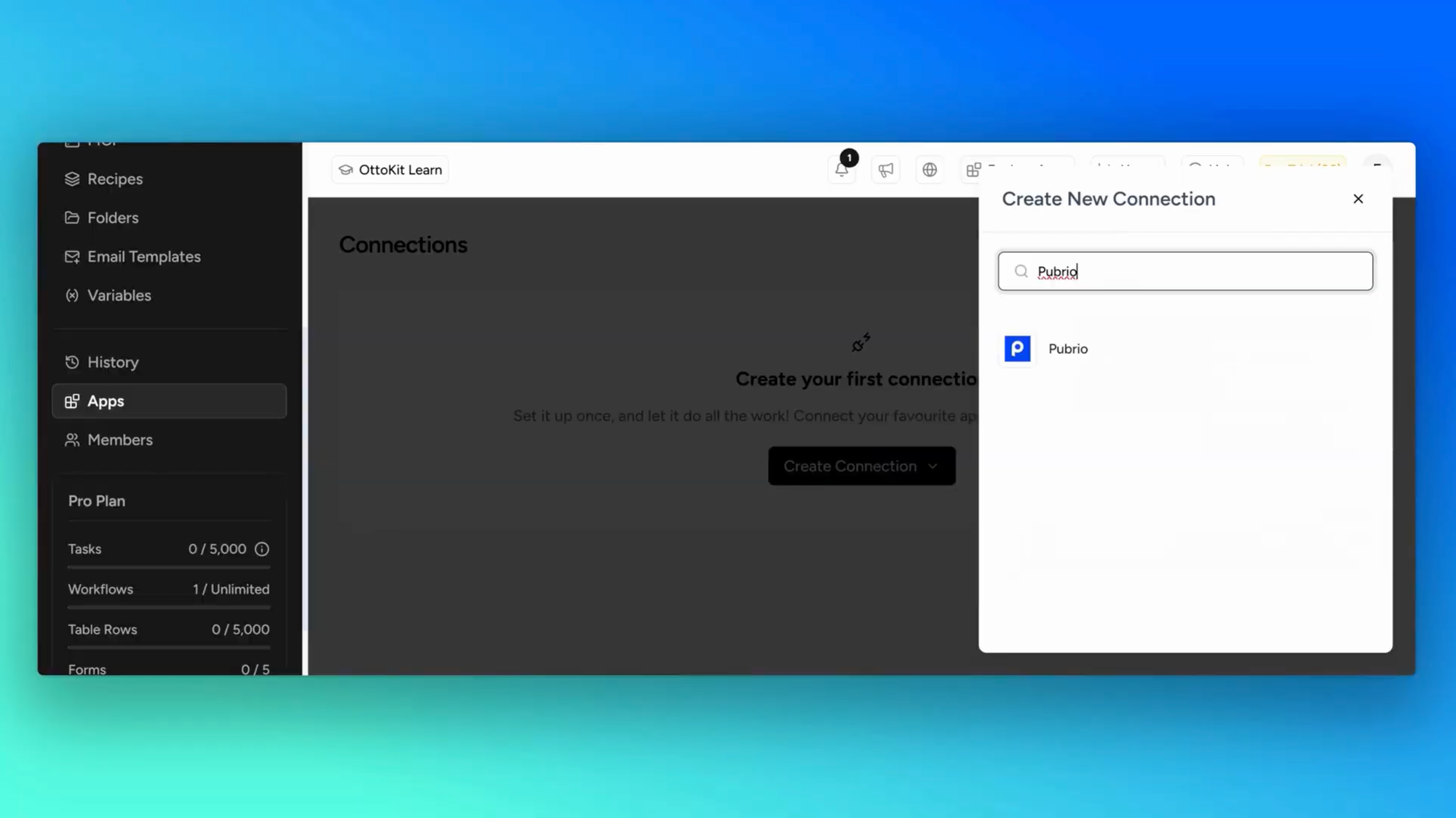
Step 1 — Open OttoKit. In your OttoKit dashboard, navigate to Apps > Create New Connection.
Step 2 — Find Pubrio under Data Providers. Locate the Pubrio card and click Connect.
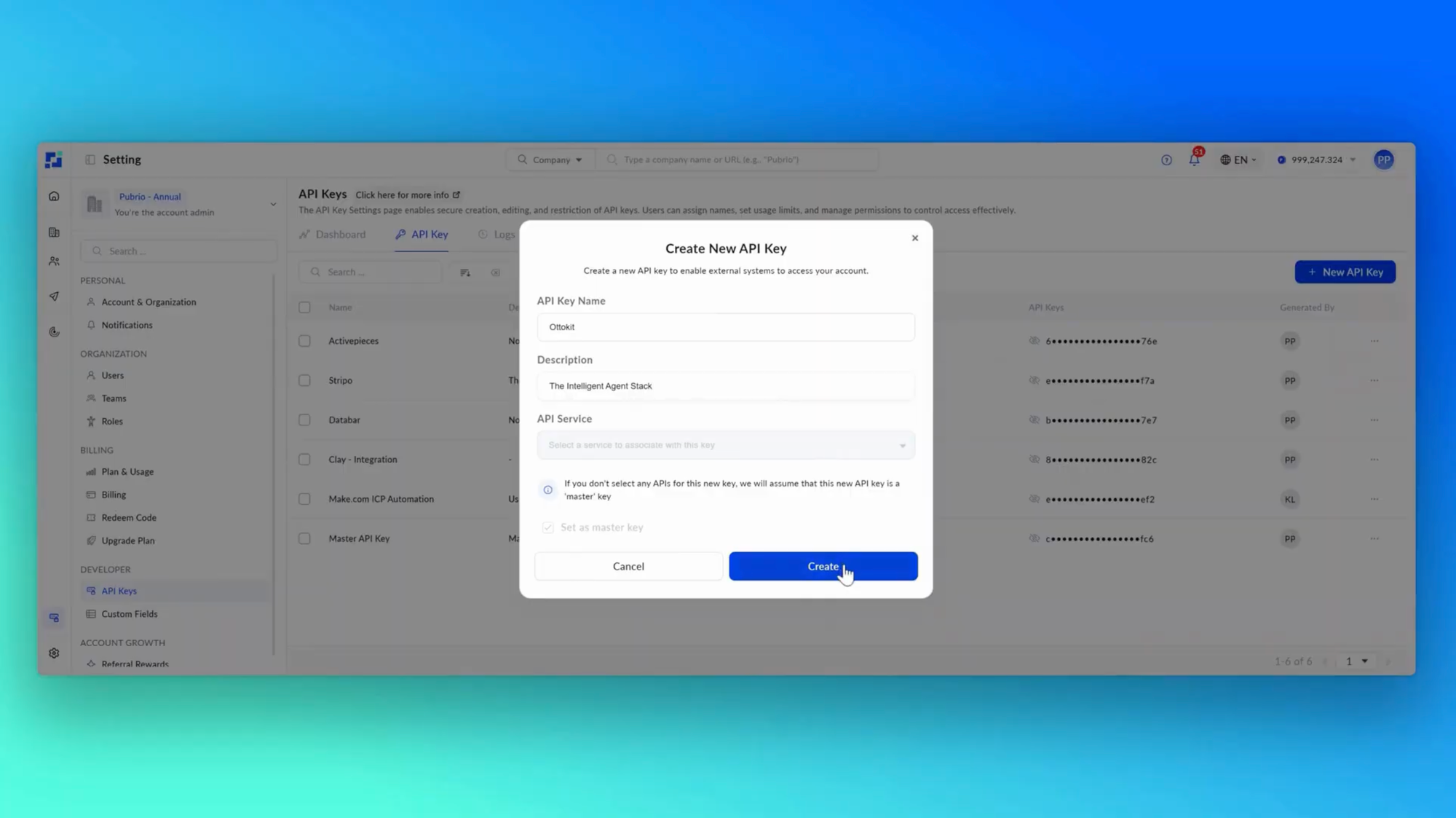
Step 3 — Enter your Pubrio API key. Retrieve your key from the Pubrio Dashboard under Settings > API. Paste it into the OttoKit authorization field.
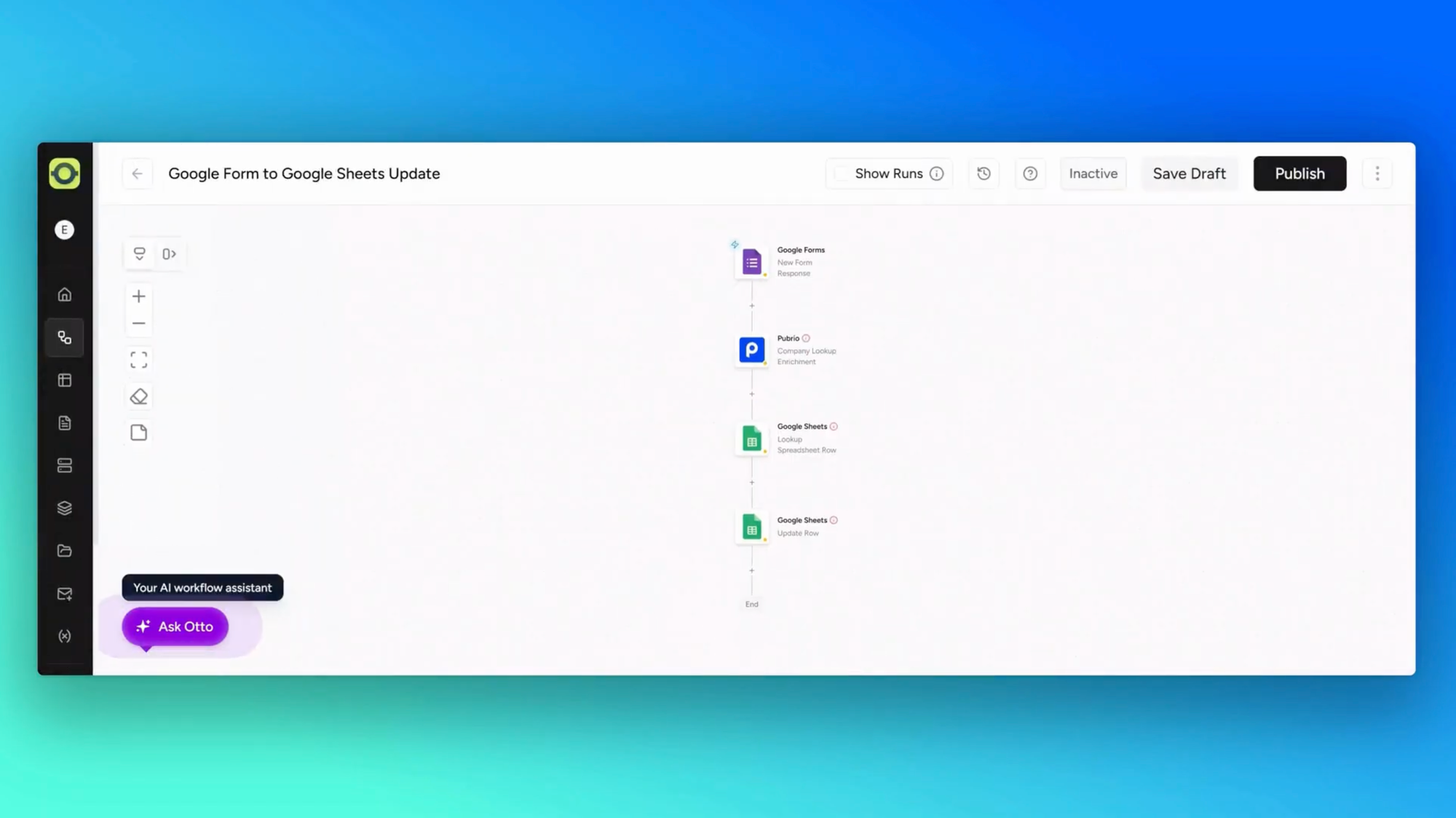
Step 4 — Add Pubrio enrichment to your workflow. In the workflow builder, add an enrichment step and select Pubrio as the data source. Set the trigger — for example "Enrich new lead" or "Verify account before outreach" — and define what Pubrio data you want returned. For advanced agent workflows, call Pubrio directly via an HTTP Request node using the Pubrio API endpoint.
| Layer | OttoKit contributes | Pubrio contributes |
|---|---|---|
| Automation engine | Visual workflow builder — triggers, conditions, actions across 1,400+ apps, no code required | Available as a native Data Provider inside OttoKit — no separate integration or API contract needed |
| AI agent intelligence | MCP-native AI agents that monitor conditions, apply logic, and act autonomously across connected tools | Local company context — employee count, tech stack, local competitors, regional business norms — so agents act with market-specific intelligence |
| Data coverage | Connects to existing data sources in the workflow — CRMs, email platforms, spreadsheets, web apps | 1B+ profiles from 50+ local registries in 200+ countries — the 70% of global companies invisible to mainstream platforms |
| Signal intelligence | Triggers workflows based on events — new lead, new record, schedule, webhook, form submission | 120,000+ daily Expansion Signals — buying indicators from local job boards, regional press, and country-specific registries |
| Pricing | Free plan (1,000 tasks/month). Paid from $9/month. Lifetime plan from $499. | Free plan available. From $125/month. No credit card required to start. |
Three workflows worth building with OttoKit and Pubrio
Global lead enrichment on inbound. When a new lead enters your CRM or submits a form, OttoKit triggers a Pubrio enrichment step — returning verified headcount, revenue range, tech stack, local business registration ID, and decision-maker contacts for that company. The enriched record flows directly to your sales tool or outreach sequence. For companies in APAC, MENA, or non-Anglophone Europe — where your current enrichment tool returns empty — Pubrio fills the gap that the rest of your stack cannot.
Signal-triggered outreach in local markets. Connect Pubrio's Expansion Signal output to an OttoKit trigger. When a company in your target market shows a high-confidence buying signal cluster — a new compliance hire, a partnership announcement in local trade press, a new subsidiary registered — OttoKit fires the outreach workflow automatically. The agent acts the week the signal fires, not the month after it surfaces on a national platform every competitor is monitoring.
AI agent personalisation for non-English markets. OttoKit's AI agent drafts outreach copy. Pubrio supplies the local context — the specific ERP system the company uses, the local employee count, the regional expansion that just appeared in local-language trade press. The agent uses this to draft outreach in the prospect's language, referencing their specific local stack and market context. The difference between a generic cold email and one that references a company's exact local technology in their own language is the difference between a delete and a reply.
A good fit for these teams
GTM engineers and RevOps teams building outbound automation for global ICPs — particularly those who have found that their current agent workflows produce strong results in the US and EU but underperform in APAC and MENA because of data coverage gaps.
Sales teams targeting private, locally active companies in Southeast Asia, MENA, and non-Anglophone Europe — the mid-market companies that generate their digital footprint through local registries and regional platforms, not LinkedIn or Crunchbase.
WordPress-based businesses expanding internationally — OttoKit's deep WordPress integration makes it the default automation choice for WordPress ecommerce, membership, and services businesses. When those businesses expand beyond English-language markets, Pubrio provides the local-source data layer that makes global automation viable.
The combination works because OttoKit and Pubrio solve different parts of the same problem. OttoKit provides the execution layer — the workflows, agents, and connections that make automation possible. Pubrio provides the intelligence layer — the locally-sourced data that makes those automations meaningful in markets they would otherwise miss.
They Need to Act Globally