The 4 Stages of International Expansion: A Complete Guide to Reaching Companies at the Right Time
Most vendors find out a company is entering a new market from a press release. By then, the decision is made. This guide breaks down the 4 stages every company goes through when expanding internationally and shows you exactly when to reach them before your competitors do.

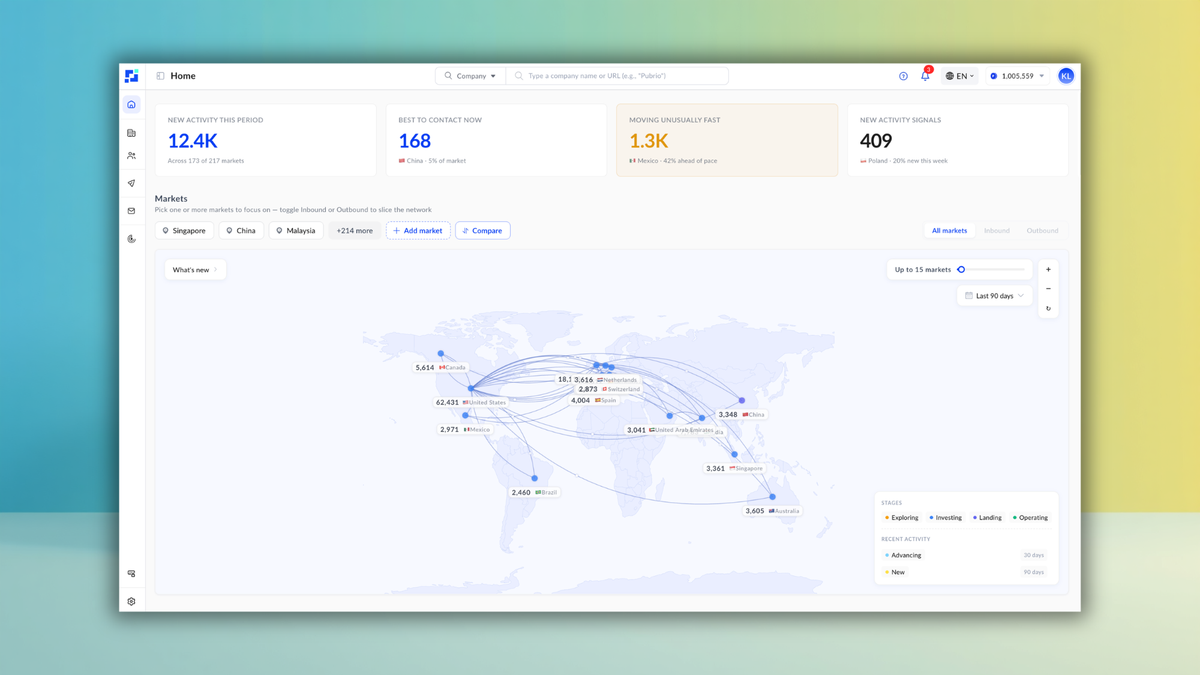
Every company expanding into a new international market moves through four stages: Exploring (interest detected, no commitment yet), Investing (real preparation underway — domains registered, local partnerships formed), Landing (entity filed, office leased, country lead hired), and Operating (team growing, product live, revenue flowing). Each stage produces observable signals — job postings, domain registrations, entity filings, conference appearances, and more. Most vendors only discover a company's expansion at Stage 3, when the press release drops. By then, the decisions are made. The vendors who win expansion revenue show up at Stage 1 and Stage 2, when the buyer is still choosing.
Most B2B vendors find out a company is entering a new market the same way everyone else does — a press release, a LinkedIn announcement, or a news alert.
By then, it is already too late.
The entity is filed. The country lead is hired. The office is leased. The budget conversation happened six months ago — and you were not in the room.
The companies that win expansion revenue do not wait for announcements. They track the signals that appear long before any press release — and they show up while the buyer is still deciding.
This guide breaks down the four stages every company goes through when expanding into a new market, what signals appear at each stage, and exactly when to make your move.
Why Expansion Happens in Stages
International expansion is not a single decision. It is a series of decisions, each one building on the last, each one leaving a trace.
A company does not wake up on Monday and file an entity in Singapore by Friday. The process takes months — sometimes over a year — involving market research, internal approvals, hiring plans, legal structuring, and operational setup.
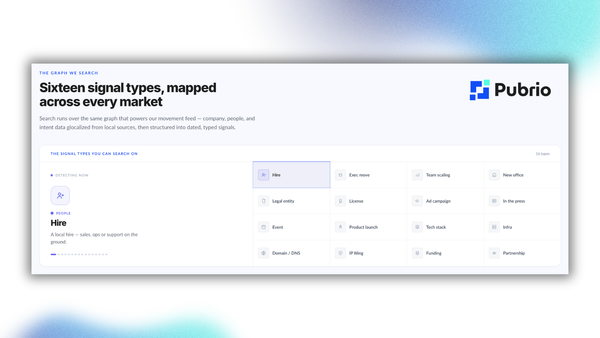
Each step produces an observable signal. A job posting in a new city. A domain registration. A conference appearance. A partnership announcement.
Individually, these signals are easy to miss. Together, they tell a clear story: which companies are moving, how serious they are, and how far along they are.
Understanding these stages is the difference between getting in the room early — and getting a polite "we've already chosen our vendors" when you finally call.
The 4 Stages of International Expansion
Stage 1 — Exploring
The company is testing the waters. They are running ads in a new market, attending local conferences, or commissioning market research. No resources committed. No decisions made. But the intention is forming.
Observable signals:
- Job postings for market research or regional strategy roles
- Conference appearances or sponsorships in the target market
- Paid advertising detected in a new geography
- Engagement with local consultants or advisory firms
What this means for vendors: This is the earliest and most valuable signal. The company is still gathering information — still open to input from vendors, partners, and advisors. A conversation at Stage 1 is a discovery call. A conversation at Stage 3 is a pitch to a locked budget.
Stage 2 — Investing
The company has moved from interest to action. They are deploying real resources, but the commitment is still reversible. This is the stage of preparation and infrastructure.
Observable signals:
- Domain registration in the target country (.sg, .de, .ae)
- Local technology deployments — CDN nodes, cloud regions, payment gateways
- Early partnership announcements with local players
- Hiring for remote or contract roles in the target market
What this means for vendors: The decision to enter is effectively made — but the operational decisions are still open. Who handles their local legal structure? Which HR platform will they use? Which logistics provider? These questions are being asked right now. Stage 2 is the sweet spot: the company is serious enough for a real budget conversation, but not so far along that everything is locked.
Stage 3 — Landing
Capital has been committed. An entity is filed, a lease is signed, a country leader is hired. The company is in the market.
Observable signals:
- Legal entity registration in the target country
- Office lease or co-working space signed
- Country manager or regional director hired
- Press release or public announcement
What this means for vendors: This is where most vendors first reach out — and where most deals are already done. The entity filing is not the beginning of the expansion. It is the end of the beginning. Vendors who win at Stage 3 almost always started the conversation at Stage 1 or 2.
Some categories are genuinely needed at Stage 3 — office fit-out, payroll processing, local compliance. For everyone else, this is a signal to learn from for the next cycle.
Stage 4 — Operating
The company is running. The team is growing, the product is live, revenue is flowing. They are no longer entering the market — they are in it.
Observable signals:
- Active local hiring across multiple functions
- Product localisation — translated interfaces, local pricing, regional features
- Local media coverage and customer case studies
- Revenue indicators — local pricing pages, payment options
What this means for vendors: Vendor relationships, tech stack, and operational processes are established. Switching costs are high. This is the hardest stage to break into — unless you offer something that scales with their growth.
Stage 4 is also a forward signal: if a company is operating successfully in one market, adjacent markets are likely next.
| Stage | Commitment level | Key signals | Vendor opportunity |
|---|---|---|---|
| Exploring | Interest only — reversible | Job postings, conference appearances, ad spend | Highest — all decisions still open |
| Investing | Serious — still reversible | Domain registrations, local partnerships, remote hiring | Very high — operational decisions open |
| Landing | Capital committed — hard to reverse | Entity filing, office lease, country lead hired | Low for most — niche categories only |
| Operating | Fully committed | Local hiring, product localisation, PR activity | Lowest — relationships established |
How to Use This in Your GTM Motion
Prioritise outreach by stage. A domain registration (Stage 2) is worth more of your time than a conference appearance (Stage 1). An entity filing (Stage 3) is a signal to move fast — or accept you may be too late.
Match your message to the stage. A Stage 1 company needs to hear how you help businesses set up in new markets. A Stage 2 company needs speed, integration, and local support. A Stage 3 company needs fast onboarding and proven scale. Same product — different angle.
Track direction, not just stage. A company at Stage 2 for six months with no movement is different from one that jumped from Stage 1 to Stage 2 in three weeks. Velocity is a buying signal. Stalling is a risk flag.
The Signal Gap: Why Most Vendors Miss the Window
There is a gap between when expansion signals appear and when most vendors act on them.
The average vendor learns about a market entry at Stage 3 — the entity filing or the press release. The earlier signals — the job postings, the domain registrations, the conference appearances — went unnoticed.
This gap exists because most sales intelligence tools are built around static data: company size, industry, revenue, technology stack. Useful for identifying who to target. Not useful for identifying when.
The "when" requires a different kind of data — one that tracks observable behaviour over time, maps it to a commitment model, and surfaces the companies that are moving right now.
into your market — right now