
Intent Signals in 2026: The 6 Types That Actually Predict a Buying Decision
Most revenue teams track 2 of these 6 intent signals and miss the majority of the buying journey. Here's what each signal is, what it looks like in practice — in US, EU, and APAC markets — and how to act on it in 2026.


- Content consumption signals — third-party topic research above baseline
- Website intent signals — first-party behavior on your own site
- Hiring and job posting signals — role additions indicating budget and need
- Funding and company event signals — capital raises, M&A, facility expansions
- Leadership change signals — new executives who reassess vendor relationships
- Technology and review platform signals — G2 comparisons, tech stack changes
Here is the problem with most B2B outbound in 2026: the deal was decided before you called.
Research from 6sense's 2025 Buyer Experience Report found that 95% of winning vendors are already on the buyer's shortlist before formal evaluation begins. Gartner confirms that B2B buyers are 70–80% through their decision process before contacting a vendor. The majority of that journey is invisible — happening in AI search tools, peer communities, review sites, and industry publications where your visibility is zero.
Intent signals change this. They are the observable behavioral evidence buyers leave behind during that invisible research phase — and the teams that track them systematically reach buyers before the shortlist closes.
Most teams track one or two signal types. The ones that consistently outperform track all six.
What Is a B2B Intent Signal?
An intent signal is any behavioral data point indicating that a company or individual is actively researching a problem, evaluating solutions, or moving toward a purchase decision. Intent signals range from anonymous content consumption patterns to explicit review platform activity.
Demandbase defines them as "the digital breadcrumbs people and companies leave behind as they research online." The key insight is that most of this research happens before any vendor contact — which means intent signals are the only way to identify in-market buyers during the period that actually determines the outcome.
The 6 B2B Intent Signal Types in 2026
1. Content Consumption Signals
What they are: Third-party topic research tracking. When employees at a company consume content about a category above their normal baseline, platforms like Bombora flag a "Company Surge." Bombora's cooperative of 5,000+ B2B publisher sites tracks 17 billion interactions monthly across 12,000+ intent topics.
Confidence level: Medium. Expect 30–50% of topic-level signals to be actionable — the rest is research noise. This is the broadest signal type and the earliest in the journey.
Global coverage gap: Content consumption networks are strongest in North America and Western Europe. In APAC markets — particularly Vietnam, Indonesia, Malaysia, and South Korea — buyers research through local platforms and non-English content ecosystems that Western cooperative networks do not index.
Real talk: "I used to send the same nurture sequence to every account on my list. Then I started filtering by content surge first — only reaching out to accounts actively researching our category. Reply rates went from 1% to around 8%. Same message, completely different timing."
2. Website Intent Signals
What they are: First-party behavioral data from your own site. The highest-confidence signal type because the buyer has already found you. Key indicators: pricing page visits, competitor comparison page views, repeat visits from the same domain, and late-funnel content downloads.
Confidence level: High. Pattern matters more than any single visit. A company visiting your pricing page twice, then downloading your ROI calculator, then a new contact from the same domain reading a case study — that cluster predicts conversion.
Example (SG): A Singapore-based company visits your pricing page Monday, reads a competitor comparison Wednesday, and a new contact downloads your implementation guide Friday. Act within 48 hours.
3. Hiring and Job Posting Signals
What they are: Role additions that broadcast budget, strategic priority, and an operational gap. When a company posts for "Revenue Operations Manager," "Clinical Informatics Lead," or "Head of Data Infrastructure," they are signaling an imminent purchase — often 4–8 weeks before any RFP.
Confidence level: High. The job description itself often contains the product keywords. Demandbase's signal taxonomy identifies job postings as a primary organizational buying signal, particularly for roles in functions your product supports.
Example (APAC): A hospital group in Malaysia posts for a "Digital Health Integration Lead." This signals active healthcare technology procurement weeks before any formal process begins — exactly the type of signal Pubrio's glocalized layer surfaces from APAC-specific job boards that mainstream platforms don't index.
Example (US): A Series B SaaS company posts three SDR roles simultaneously. They need outreach tooling and data infrastructure — now.
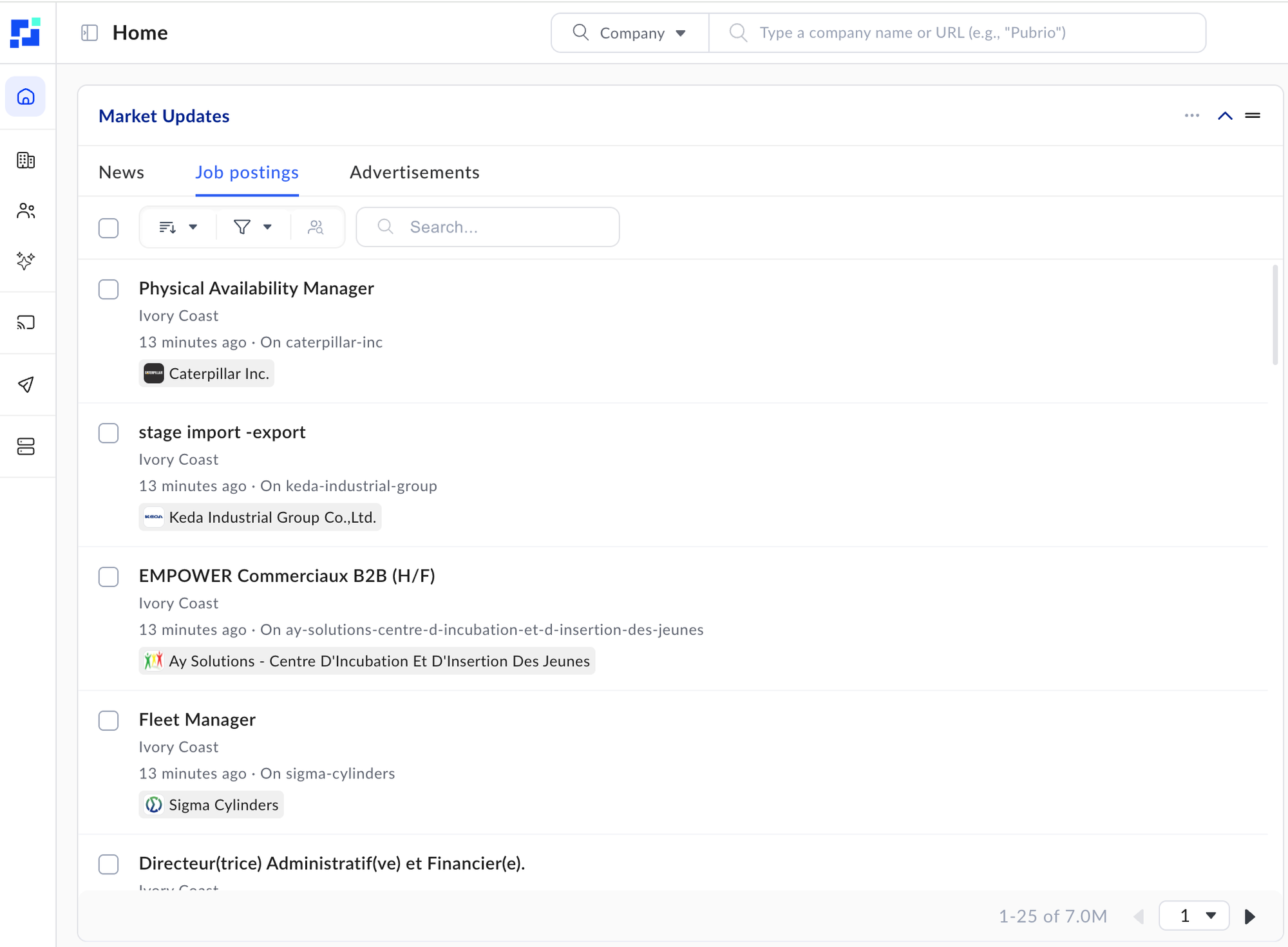
Real talk: "I was old school — cold calling from a spreadsheet, no logic to who I called next. My manager showed me a job posting filter: any company hiring for RevOps or Sales Enablement within our ICP was a priority call that week. That one change cut my list from 200 accounts to 40, and my connect rate doubled."
4. Funding and Company Event Signals
What they are: Capital raises, M&A activity, new facility announcements, and product launches — events that create fresh budget, growth mandates, and fast decision timelines. A company that has just raised capital will typically hire, invest in tools, and build processes within six months of announcement.
Confidence level: High, but time-sensitive. Signal value decays fast — a funding round from yesterday is hot; the same round from four months ago has been acted on by every competitor tracking the same feed.
Example (EU): A UK fintech closes a £12M Series A and immediately posts for a Head of Sales and Marketing Ops Lead. The funding + hiring cluster is a high-confidence buying signal. The outreach window is the first 30 days.
Example (APAC): A hospital group in the Philippines announces a new facility opening. This signals an immediate procurement cycle for clinical equipment and digital health infrastructure — visible only to platforms with local APAC news and registry coverage.
5. Leadership Change Signals
What they are: New executives — particularly at VP level and above — who arrive with new priorities, new budgets, and no loyalty to incumbent vendors. Gartner's research finds 99% of B2B purchases are ultimately driven by organizational changes, making leadership transitions one of the most reliable procurement triggers.
Confidence level: High. Role matters: a new CIO or CTO signals infrastructure review; a new VP of Sales means the outbound stack is under evaluation; a new CMO will typically audit MarTech within 90 days.
Example (global): A manufacturing company in South Korea appoints a new VP of Operations with a background in digital transformation. This signals operational technology is about to come under review. The engagement window is 30–60 days from appointment.
6. Technology and Review Platform Signals
What they are: The highest-confidence, shortest-window signals available. G2 profile views, TrustRadius competitor comparisons, and technology stack changes indicate a company is in active vendor evaluation — not early research.
Confidence level: Very high. Salesmotion's 2026 research puts actionability rates for platform-specific signals at 50–70%, compared to 30–50% for topic-level content consumption signals.
Example: A B2B software company in Singapore views your G2 profile, reads your head-to-head comparison with a competitor, and three contacts from the same domain appear on TrustRadius within seven days. This cluster indicates a decision within two to four weeks.
Real talk: "My manager told me intent data was just another subscription nobody would use. Then one morning I saw a notification — five contacts from an account I'd written off six months ago had all viewed our G2 profile within 48 hours. I called their Head of Ops that day. They were mid-evaluation. We got on the shortlist. We closed. That one signal paid for the tool for two years."
| Signal Type | Confidence | Decision Window | APAC Coverage Gap |
|---|---|---|---|
| Content consumption | Medium | 60–120 days | High |
| Website intent | High | 14–30 days | Low |
| Hiring signals | High | 30–90 days | High |
| Funding & events | High | 0–30 days | High |
| Leadership changes | High | 30–60 days | Medium |
| Review platform | Very High | 7–21 days | Medium |
How to Layer Signals: The Pattern That Predicts Conversion
A single signal is rarely enough. The pattern that predicts conversion is signal clustering — multiple signal types converging on the same account within a 7–14 day window. Three high-confidence combinations:
Hiring + Content consumption: A company posts a RevOps role while simultaneously showing topic research surges. The hiring signal reveals the need; the content consumption confirms active evaluation.
Funding + Hiring: A company closes a funding round and begins posting SDR roles. Fresh capital, growth mandate, outbound team expansion — this cluster indicates an immediate need for sales tooling and data.
Review platform + Leadership change: A new VP of Sales joins and within two weeks your G2 profile is viewed by multiple contacts from that domain. The executive is auditing the stack and your product is in active evaluation.
The operational key is speed. Most buying decisions reach a shortlist within two weeks. Signal value decays fast — act on clusters within 48–72 hours of detection.
Global Signal Coverage Gap
Most intent data platforms were built for English-language, North American B2B markets. Bombora's cooperative — the dominant third-party signal network — draws from 5,000+ publisher sites, the majority English-language and Western in origin.
This creates a systematic blind spot for APAC. According to Forrester's 2025 research, APAC buyers involve more stakeholders (15 internal members vs a global average of 13) and prioritise cultural alignment and trust — meaning vendor visibility during the anonymous research phase is even more important than in other markets.
APAC B2B buyers are now contacting sellers roughly 12 weeks earlier than in 2024 — which compresses the window and makes missing early signals even more costly.
Pubrio's glocalized data layer addresses this by aggregating signals from 50+ localized sources across 130+ countries — including APAC-specific job boards, regional business registries, and local-language news ecosystems that mainstream platforms miss. The result: signal coverage that extends to the markets your current stack cannot see.
Pubrio aggregates 120,000+ daily intent signals from 50+ localized sources globally — including the hiring events, funding rounds, and leadership changes your current stack cannot see.
Get a Demo Start Free Trial