
The Data Enrichment Stack: What Global Revenue Teams Are Using in 2026 (And What's Missing)
Most enrichment stacks can only see 30% of your global market. Here is what global revenue teams are building in 2026 — and the structural gap that waterfall enrichment alone cannot fix.


Most global revenue teams layer three tiers: a contact enrichment tool for emails and direct dials, a waterfall orchestration layer that sequences multiple providers to maximize match rates, and an account intelligence platform for firmographics, technographics, and intent signals. The gap that none of them solve: every tool in this stack was built from North American and English-language data infrastructure. For teams targeting APAC, MENA, or non-English-speaking markets, the enrichment stack is running against a data layer that structurally cannot see the majority of their addressable market. A glocalized data layer — one built from 50+ localized sources in each market, surfacing Expansion Signals from funding, hiring, partnerships, and local business activity — is what closes that gap.
Every B2B revenue team has a data problem. It just looks different depending on what you are trying to do.
For teams running outbound in North America, the problem is accuracy and freshness — stale emails, wrong phone numbers, titles that changed six months ago. For teams expanding into Europe, the problem is compliance — GDPR, legitimate interest, DNC registries that vary by country. For teams targeting APAC, MENA, Southeast Asia, or any non-English-speaking market, the problem is structural: the data layer your enrichment tool sits on was not built to see those markets in the first place.
In 2026, bad data costs the average B2B company $12.9 million annually — and that figure assumes your data tool can actually find the companies you are targeting. For global revenue teams, the real number is higher, because the gap between what the tool says it covers and what it can actually return for your specific market is where most of the budget bleeds out quietly.
This guide breaks down what global revenue teams are actually building for data enrichment in 2026, what each tier of the stack does, where the structural gap lives, and how Pubrio's glocalized data layer and Expansion Signal approach closes it.
The Three-Tier Enrichment Stack
The B2B data enrichment market has matured into three recognizable tiers. Most high-performing teams layer at least two.
Tier 1: Contact enrichment — fills CRM fields with verified emails, direct dials, job titles, and firmographic data. Answers the question "who works at this company and how do I reach them?" Keeps records current as contacts change roles.
Tier 2: Workflow orchestration — connects multiple data providers in a waterfall sequence. When one source misses a field, the next one fills it. Reduces single-source dependency and increases overall match rates significantly.
Tier 3: Account intelligence — layers in technographic data, intent signals, hiring patterns, and funding activity on top of contact data. Answers "which accounts are in-market right now and why?" — the timing layer that separates relevant outreach from noise.
No single platform dominates all three tiers well. The strongest results come from a deliberate layered stack, not a single all-in-one subscription applied uniformly across every market.
Tier 1: Contact Enrichment — What Teams Are Running
Most contact enrichment platforms work the same way: they maintain a proprietary database of professional profiles, sourced primarily from LinkedIn, web crawls, and North American company registries, then let you query that database to fill CRM fields. The quality differentiation sits in three areas: accuracy rates (what percentage of returned emails actually deliver), refresh cadence (how often the database updates), and regional coverage depth.
"I was running outbound into Southeast Asia with the same enrichment tool we used for the US market. Bounce rate was 35%. When we audited it, our contact match rate for the actual addressable market in the region was around 30%. The tool wasn't failing — it just didn't have the data." — Sales ops lead, B2B SaaS, APAC market entry
Where most platforms are strong: English-speaking markets, large enterprises with significant LinkedIn presences, North American and tier-1 European markets.
Where most platforms are weak: Mid-market companies in Germany, Japan, South Korea, Vietnam, Indonesia. Regional businesses in MENA that operate through Arabic-language platforms. Manufacturing, logistics, and professional services firms in any market that do not maintain LinkedIn profiles. Local businesses across Southeast Asia registered only in country-specific registries.
This is not a provider-specific criticism — it is an architecture observation. Platforms built from English-language web infrastructure systematically miss markets that do not generate English-language digital footprints. The coverage gap is structural, not incidental.
Tier 2: Workflow Orchestration — Waterfall Enrichment
A single enrichment source typically matches 55–70% of a contact list. Adding a second provider in sequence recovers another 15–25% of missed records. A third adds another 8–12%, pushing total match rates toward 80–92%.
This is why waterfall enrichment became the dominant architecture for RevOps teams: querying multiple providers in sequence, moving to the next only when the previous returns a blank, maximizes field coverage without manual intervention.
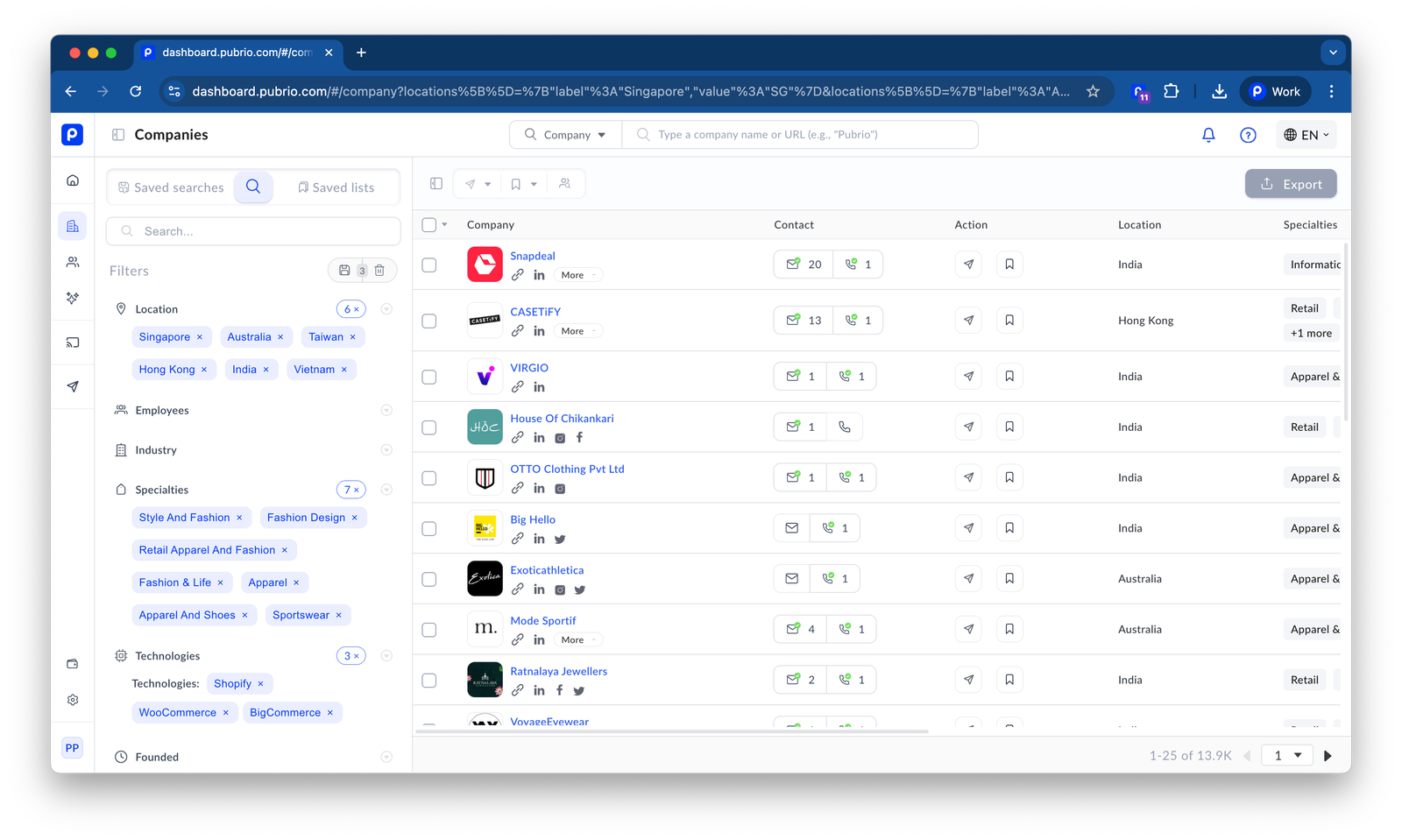
Tools like Clay made this orchestration accessible to non-engineering teams — connecting dozens of data providers visually, letting teams build enrichment sequences without code. Pubrio integrates directly into Clay workflows, allowing revenue teams to tap Pubrio's glocalized business graph alongside other providers. For markets in APAC and MENA where mainstream providers return thin or empty results, Pubrio's local-source data fills the gaps that a waterfall of English-language providers cannot.
"By connecting Clay with Pubrio's glocalized business graph, we went beyond the usual 30% of well-indexed companies and uncovered the real long tail across North America, EMEA, and APAC. Pubrio's local signals plugged directly into Clay workflows, so we could build live lists of local businesses in any market without changing our existing playbooks." — GTM engineer, revenue team using Pubrio + Clay integration
The limit of waterfall enrichment: Sequencing providers increases match rates — but only within the universe of companies those providers can see. If every provider in your waterfall draws from the same English-language source infrastructure, querying them in sequence still returns empty for markets none of them have indexed. Waterfall enrichment is a coverage optimization, not a coverage solution.
| Tier | What it does | Strong in | Weak in | Pubrio's role |
|---|---|---|---|---|
| Contact enrichment | Fills emails, phone, titles, firmographics | US, Canada, UK, DACH, Nordics | SEA, MENA, non-LinkedIn markets | 50+ local sources fill the gap |
| Waterfall orchestration | Sequences providers to maximize match rate | Any market with multiple providers | Markets where all providers share same source | Plugs into Clay as a glocalized fallback |
| Account intelligence | Intent signals, technographics, timing | English-language digital behavior | Non-English intent, local news signals | 120K+ Expansion Signals from local ecosystems |
| Pubrio glocalized layer | Source + enrich + signal in one data graph | 130+ countries from local sources | — | The missing data layer |
Tier 3: Account Intelligence — Timing the Outreach
Contact enrichment tells you who works at an account and how to reach them. Account intelligence tells you why and when to reach out.
The best account intelligence platforms — intent data providers, ABM tools, technographic trackers — do something genuinely valuable: they surface which accounts are actively researching a solution like yours right now, so reps can reach out at the moment of highest receptivity rather than on a cold, arbitrary schedule.
The limitation most teams discover when they expand globally: these platforms track English-language digital behavior. They monitor content consumption on English-language sites, searches on English-language platforms, and engagement with English-language content networks. A company in Kuala Lumpur actively researching your category on local-language platforms does not appear in the intent co-op. A manufacturer in Vietnam posting compliance-related jobs on local job boards does not trigger a hiring signal. A regional distributor in Saudi Arabia announcing a new partnership in Arabic-language trade press does not surface as an account showing buying intent.
The signal exists. The infrastructure to read it does not — unless the data layer was built from local sources.
The Gap Nobody Talks About
Every tier of the standard enrichment stack shares the same architectural foundation: English-language web crawls, LinkedIn profiles, and North American company registries, extended outward and labeled as global.
This produces excellent data for a specific universe of companies — large, English-language, digitally active, primarily North American and tier-1 European. It produces thin, inaccurate, or absent data for the majority of global business activity, which happens outside that universe.
"We built an AI agent to qualify inbound leads overnight. It worked brilliantly for North American companies. The moment we pointed it at MENA and Southeast Asia, it stalled — not because the AI was wrong, but because the data layer it was drawing from had never seen those markets clearly. Glocalized data infrastructure is what made the agent actually useful globally." — GTM engineer, AI-native revenue team
What this means for a global revenue team in practice:
- Your CRM enrichment is accurate for the contacts your tool could find — not for the full addressable market you are targeting
- Your ICP is being validated against a 30% sample of the actual market, not the full 100%
- Your AI agents inherit the coverage gap of the data layer they sit on
- Your intent signals reflect English-language buying behavior, not buying activity in non-English markets
- Your waterfall enrichment is maximizing fill rates within an already incomplete universe
This is not solvable by adding more providers of the same type. It requires a different source architecture.
What Pubrio's Glocalized Data Layer Changes
Pubrio was built on a different architectural premise: instead of extending from one global professional network outward, it aggregates from 50+ localized data sources in each market — country-specific business registries, regional hiring platforms, local-language news ecosystems, industry directories, and web signals that exist outside English-language infrastructure — and normalizes them into a single structured global graph covering 560M+ professionals and 800M+ companies across 130+ countries.
The practical difference: a mid-market logistics company in Kuala Lumpur that has no LinkedIn presence is present and enrichable. A regional construction firm in Saudi Arabia appears with accurate firmographic data sourced from local registries. A manufacturer in Vietnam with no English-language footprint has structured contact data because the source is the Vietnamese business registry, not an English-language crawl.
Expansion Signals: The Timing Layer Built for Global Markets
Standard intent data tracks English-language research behavior. Pubrio's Expansion Signal layer works differently.
Expansion Signals are real-time buying indicators sourced from local ecosystems in each market — not only from English-language intent networks. Pubrio generates 120,000+ daily signals across categories including:
- Funding events — new investment rounds surfaced from local financial news, regional VC announcements, and country-specific funding databases
- Hiring signals — role postings on local job platforms that indicate team expansion, new department formation, or technology evaluation cycles
- Partnership announcements — joint venture and distribution agreements published in local-language trade press that signal market entry or expansion
- Ad activity — companies running new advertising campaigns, indicating active go-to-market investment
- Technology signals — new software adoption, digital infrastructure changes, and platform migrations visible through local web signals
- News and launches — product launches, market expansions, and leadership changes published in local-language media before they appear in English-language sources
The signal is what makes the data actionable. Knowing a company exists in your target market is table stakes. Knowing that the same company just posted three compliance-related roles, announced a new regional partnership, and started running LinkedIn ads targeting enterprise buyers — that is Expansion Signal intelligence. That is the timing layer.
"I used to work purely off cold call lists. Spray and pray. When we switched to a data layer with actual local signals — companies posting on regional job boards, announcing partnerships through local press — the first thing I noticed was accounts I'd never seen before showing clear buying intent. They just hadn't been visible in English-language infrastructure." — Revenue intelligence lead, global B2B team
For CRM enrichment: Pubrio's Sheets product enriches existing CRM records with structured data sourced from local registries and real-time signals — keeping contact records current using the same local-source infrastructure that makes discovery possible in the first place.
For AI agents: Pubrio's unified API delivers enriched, signal-tagged business data directly into AI workflows — so agents running lead qualification, account research, or territory mapping in APAC and MENA markets have the same data quality and signal coverage as agents running the same workflows in North America.
For market entry: The combination of glocalized company data and Expansion Signals makes Pubrio particularly valuable for teams entering new markets. Rather than building a list from a thin regional database and waiting for English-language signals to appear, teams can identify the full addressable market and prioritize accounts already showing local buying activity from day one.