
What Is an Expansion Signal? The Complete Definition for B2B Revenue Teams
An Expansion Signal is a verifiable business event showing a company is entering a new market — from geo-targeted ads at Exploring stage to entity registration at Expanding. Not inferred behaviour. A real event. This is the complete definition.

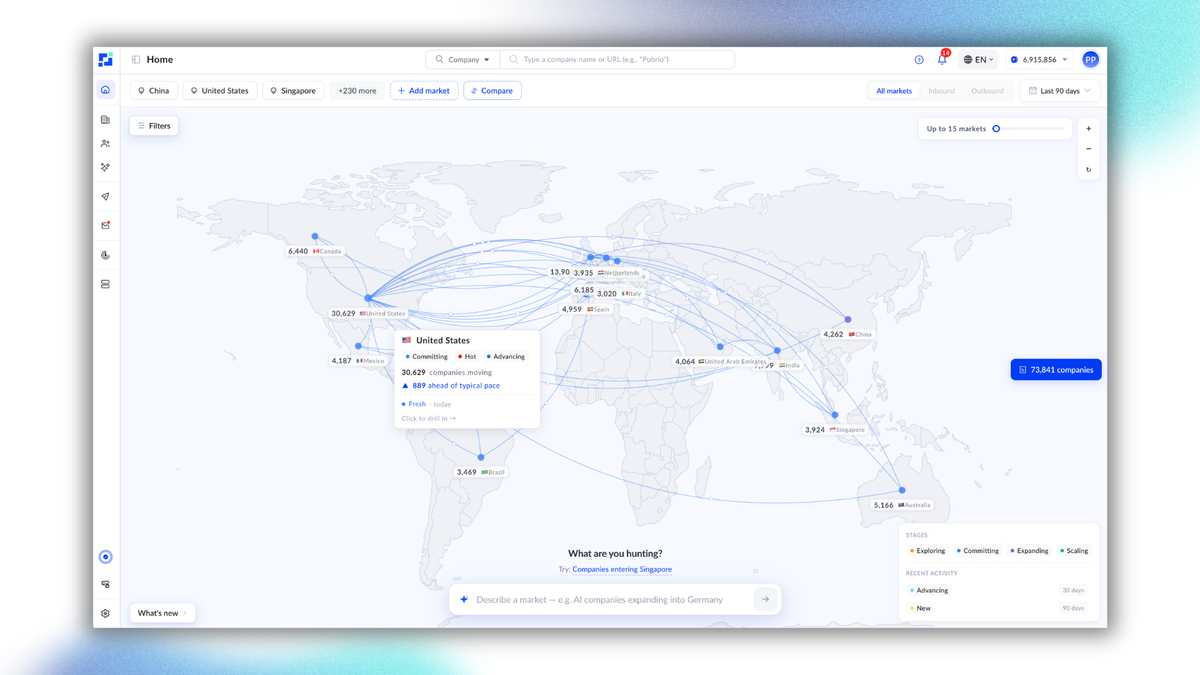
An Expansion Signal is a verifiable business event indicating a company is actively entering or scaling in a new market — sourced from local registries, regional job platforms, and local-language trade press, not inferred from anonymous content consumption. Expansion Signals include: new subsidiary registrations in country-specific business registries, country manager and local leadership hires on regional job platforms, local partnership announcements in local-language financial press, compliance and technology hiring surges that indicate a regulatory or infrastructure procurement cycle, and office opening announcements that precede formal press releases by days to weeks. Expansion Signals differ from intent data (which tracks anonymous research behaviour across content co-ops) and from general buying signals (which can be triggered by any business event) because they specifically indicate geographic market entry or scaling — the moment when a company simultaneously creates procurement needs across 10–15 vendor categories. Pubrio generates 120,000+ daily Expansion Signals from local ecosystems across 220 markets.
The definition
An Expansion Signal is a verifiable business event indicating a company is actively entering or scaling in a new geographic market.
It is a legal filing, a job posting, a signed office lease, a partnership announcement — cross-referenceable against a primary source. Not an inferred behaviour. Not content consumption. A verifiable event.
Two concepts revenue teams often conflate with it:
Intent data tracks anonymous research behaviour — which companies are consuming content about topics related to your category across publisher networks. It infers readiness from digital body language. It cannot confirm whether a company is actually entering a new market or merely exploring the idea.
General buying signals cover any observable event that indicates a company may be entering a procurement cycle — funding rounds, leadership hires, technology adoption. These are valuable, but they apply to a company's general buying activity, not specifically to market entry. A company hiring a new CTO is a buying signal. A company registering a subsidiary in Indonesia's AHU registry, posting a country manager role on Kalibrr, and announcing a local partnership in Bisnis Indonesia — all within 30 days — is an Expansion Signal cluster. The specificity is different. So is the procurement implication.
Why market entry creates the most concentrated buying window in B2B
A single market entry creates buying needs across 10–15 vendor categories simultaneously. The company entering a new geography needs: compliance and regulatory tools, HR and payroll infrastructure for local employees, CRM and sales tools for the new team, market intelligence and data providers, local banking and financial services, office infrastructure, legal and entity management, and in many cases localised versions of products they already use in their home market.
As Harvard Business Review research has shown, first-mover advantage in B2B sales is real: the vendor who helps frame the problem wins the deal 74% of the time. The expansion moment is the highest-value window because it is the moment when all of those procurement decisions are open simultaneously — and the shortlist has not yet formed.
Companies in expansion mode are investing, not cutting. They're more likely to rethink existing processes — and 35–50% of sales go to the supplier who engages first (HubSpot).
Four types of Expansion Signals
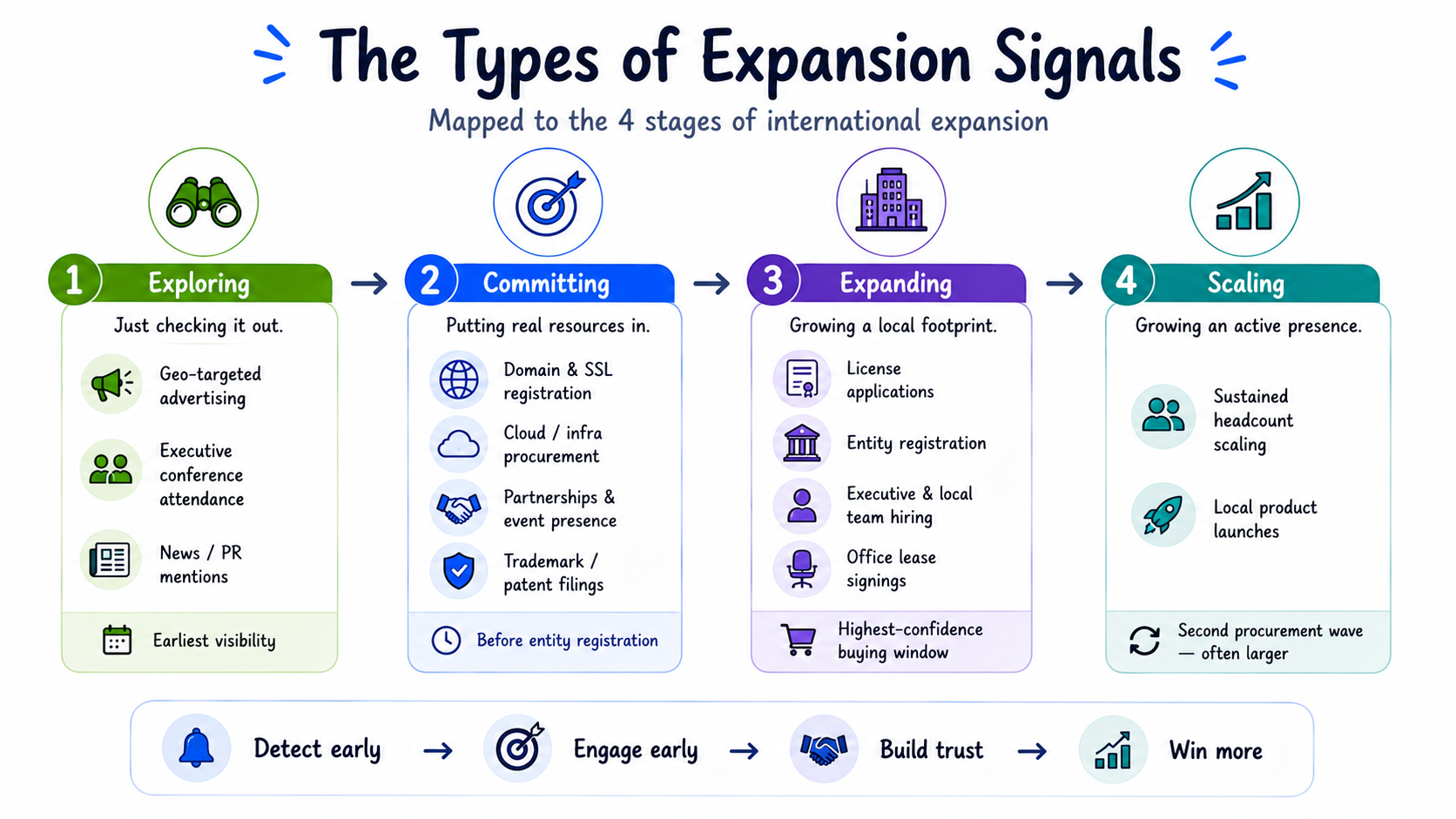
Expansion Signals fall into four categories, mapped to the four stages of international expansion: Exploring, Committing, Expanding, and Scaling.
Exploring — just checking it out. No commitment yet, but the signals are already visible. Pubrio monitors: geo-targeted advertising in the target market, conference attendance by executives, and news or PR coverage mentioning a new geography. These appear months before any legal or operational step — and create the earliest relationship window for vendors who are paying attention.
Committing — putting real resources in. The company has made an internal decision; money and effort are being allocated. Pubrio monitors: domain and SSL registration for the target market, product localisation work, cloud and infrastructure procurement, trademark and patent filings, local partnership announcements, and exhibiting or speaking at regional events. These signals fire before any entity is legally registered — meaning vendors who detect them are ahead of those waiting for the Expanding stage.
Expanding — growing a local footprint. This is the highest-confidence buying window. Legal and operational commitment is now visible in official sources. Pubrio monitors: regulatory licence applications, entity registration in the country's official business registry, executive hires in the target market, office lease signings, and local team hiring on regional job platforms. The country manager hired at this stage evaluates 10–15 vendor categories within their first 90 days — and the shortlist forms fast.
Scaling — growing an active local presence. The company is operational and now expanding its footprint. Pubrio monitors: sustained headcount scaling across local teams, and local product launches that signal the market is being treated as a full operating territory rather than a pilot. This stage creates a second procurement wave — often larger than the initial Expanding stage contracts — as entry-level tools are replaced with enterprise solutions built for the local scale.
Where Expansion Signals come from
Office announcements come 2–4 weeks after a lease is signed. The Committing-stage registry filing comes before that. The Exploring-stage hiring signal comes before that. The further upstream you detect, the less competition you face.
Most tools detect signals after they travel through English-language channels. A new entity filing appears in Crunchbase days to weeks later — if at all. A country manager hired on local job platforms generates no LinkedIn alert without an active profile. Pubrio's Expansion Signal layer monitors local registries, job platforms, and local-language trade press at the point of origin — 120,000+ daily signals across 200+ markets that English-language tools cannot see.
How Expansion Signals differ from intent data
The clearest way to distinguish them:
Intent data answers: "Is this company researching topics related to my category?" An Expansion Signal answers: "Is this company entering or scaling in a market where they will need solutions like mine?"
Intent data is anonymous and inferred. Expansion Signals are verifiable and sourced. Intent data is available to every subscriber of the same co-op simultaneously. A registry filing sourced from a local system in real time arrives before most competitors' tools carry it. Intent data captures research behaviour in English-language publisher networks — generating no signal for companies whose buyers research in Vietnamese, Bahasa Indonesia, Arabic, or Korean. Expansion Signals are sourced from the legal and professional infrastructure of each market, regardless of language.
The two are complementary: intent data tells you who is researching your category; Expansion Signals tell you who is committing to a new market.
| Dimension | Intent data | General buying signals | Expansion Signals (Pubrio) |
|---|---|---|---|
| Signal basis | Anonymous research behaviour across content co-ops | Observable business events — funding, hires, tech adoption | Verifiable market entry events — registry filings, local hires, local partnerships |
| Source | English-language publisher networks (Bombora, G2) | LinkedIn, Crunchbase, English-language press | Local registries, regional job platforms, local-language trade press — 200+ markets |
| Question answered | Is this company researching my category? | Is this company entering a procurement cycle? | Is this company entering a new market — creating 10–15 simultaneous vendor needs? |
| Global coverage | English-language markets only — no APAC / MENA local coverage | Primarily English-language — LinkedIn and Crunchbase lag in APAC / MENA | Local-source coverage in 200+ markets — including markets with no English-language data |
| Timing | 1–7 day lag between behaviour and delivery | Days to weeks after event appears in English-language channels | At point of local origin — registry filings surfaced the day they are filed |
| Competitive exclusivity | Shared with all co-op subscribers simultaneously | Available to all LinkedIn / Crunchbase users | Local-source signals surface before national platforms carry them |
Pubrio's Expansion Signal layer
Pubrio built the first B2B data layer specifically designed to surface Expansion Signals from local sources in real time. Its data infrastructure sources from 50+ local registries alongside regional job platforms and local-language trade press in each market.
The result: 120,000+ daily Expansion Signals mapped to the four expansion stages, delivered via API and MCP-native integrations to Clay, OttoKit, Make.com, HubSpot, and Salesforce. When a company registers a subsidiary in local registries, hires a country manager on local job platforms, and announces a partnership in local trade press within 30 days, Pubrio surfaces all three as a signal cluster — identifying the account as a Committing-to-Expanding transition with a 2–8 week procurement window — before any of this reaches LinkedIn or Crunchbase.
800M+ companies from 50+ local sources across 200+ markets. Free plan available. From $125/month.
From Local Ecosystems Across 220 Markets